There was only one lion
The Horse and His Boy“There was only one lion” is Aslan’s explanation to Shasta that the apparently separate lions along his journey were all one presence: Aslan himself. The revelation gathers danger, comfort, and rescue into a pattern of guidance, but its final limit is as important as its disclosure: Aslan will tell Shasta his own story, not Aravis’s.
The Revelation
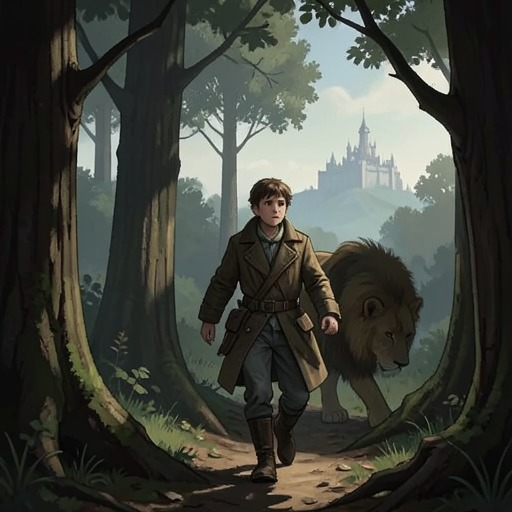
When Shasta objects that he met more than one lion, the Voice answers, “There was only one lion,” then clarifies, “There was only one: but he was swift of foot.” The exchange recasts Shasta’s recollections. What had seemed to be several encounters becomes the work of a single agent moving quickly between them.
Shasta asks how the Voice can know. Aslan replies, “I was the lion.” The short declaration identifies the speaker with the figure behind the journey’s recurring danger and help. The phrase is therefore both a correction of Shasta’s count and a disclosure of who has been acting in the scenes he remembers.
The Journey Gathered into One Pattern
Aslan names the different forms his intervention took. He was the lion who forced Shasta to join Aravis, the cat who comforted him among the houses of the dead, and the lion who drove the jackals away while he slept. The threatening and reassuring appearances belong to the same course of action, rather than to unrelated creatures or accidents.
The revelation also reaches beyond the encounters Shasta can recall clearly. Aslan says he gave the Horses a new strength born of fear for the last mile, enabling them to reach King Lune in time. He further identifies himself as the lion Shasta does not remember: the one who pushed the boat carrying Shasta, a child near death, to shore, where a man was awake at midnight to receive him. Thus the explanation joins the present conversation to Shasta’s infancy and to the start of his life with Arsheesh.
What the Revelation Withholds
Shasta immediately asks whether Aslan was also the lion who wounded Aravis. Aslan confirms that he was. But when Shasta asks why, Aslan refuses to explain, saying, “I am telling you your story, not hers. I tell no one any story but his own.” The limit does not undo the revelation; it defines its scope. Shasta is shown how Aslan’s actions shaped his own path, but is not given access to Aravis’s experience simply because their journeys have become connected.
The paired statements—“There was only one lion” and “I tell no one any story but his own”—organize the scene around recognition and restraint. The first makes many incidents legible as one continuing presence; the second insists that understanding remains personal and bounded. Aslan’s account explains the pattern behind Shasta’s experiences without making another person’s story his to disclose.
Narrative Significance
The phrase’s force comes from its reversal of appearances: repeated danger had suggested repeated lions, while the explanation reveals a single guide working through different encounters. The same lion can drive Shasta onward, comfort him, protect him, and preserve him before he knows there is a story to tell. The revelation changes how the journey’s hardships can be read, without claiming that Shasta understood their meaning as they happened.
The scene also binds providence to individual perspective. Aslan can disclose the connections among Shasta’s own experiences, including events from before Shasta could remember, while withholding the reason for Aravis’s wound. The phrase names unity across the journey; the closing rule prevents that unity from becoming permission to possess another person’s history.